Tag: tech

  • 8 Ways Lineview’s New SaaS Platform ‘Navigator’ Is Changing the Future of Manufacturing

    8 Ways Lineview’s New SaaS Platform ‘Navigator’ Is Changing the Future of Manufacturing

    A man in a hard hat examining data on a tablet in a manufacturing environment, with a robotic arm in the background. Another worker in an orange vest reviewing a tablet, surrounded by digital data representations symbolizing manufacturing technology.

    Lineview has just unveiled Navigator, its first-ever software-as-a-service (SaaS) platform, promising to redefine how manufacturers use data to boost efficiency, cut costs, and future-proof their operations.

    Here’s a closer look at what makes this launch a big deal in the world of smart factories.

    1. Real-time insights, anytime, anywhere
    Navigator gives plant managers instant visibility into production line status with live, minute-level data. With a seven-day live window and up to a year of historical storage, decision-makers can quickly spot issues and compare past performance.

    2. Three powerful modules in one
    The platform is divided into Navigator Monitor, Navigator Review, and Navigator Analyse. Together, they bridge the gap between raw data collection and actionable improvements, making it easier to prioritize fixes and track results.

    3. Root cause analysis made simple
    Navigator doesn’t just flag inefficiencies. It drills down to identify the actual causes of production loss, helping factories optimize their overall equipment effectiveness (OEE) across multiple sites.

    4. Smarter collaboration across locations
    Data isn’t siloed anymore. Teams can share dashboards, benchmark against other plants, and apply best practices faster, turning manufacturing into a truly collaborative effort.

    5. Seamless integration with existing systems
    From ERP and SAP to warehouse and maintenance software, Navigator’s API connections make it easy to plug into existing digital networks. It can even pull in live feeds from energy and condition monitoring systems to connect the full supply chain.

    6. Automatic updates and zero downtime
    Because it’s SaaS-based, Navigator ensures customers always have access to the latest features without the hassle of manual upgrades. The result is faster deployment and lower IT overhead.

    7. A step toward predictive manufacturing
    Instead of reacting to breakdowns, Navigator helps operators anticipate problems before they escalate. With automated fault detection and built-in workflows, factories can move from firefighting to future-proofing.

    8. Industry-wide momentum for manufacturing intelligence
    Lineview’s launch aligns with forecasts predicting the global manufacturing analytics market will hit US$63.5 billion by 2030. As more companies embrace centralised dashboards and cross-site data sharing, Navigator positions itself as a game-changer for efficiency and growth.

    Steve Adams, CEO at Lineview, summed it up: “Navigator brings intelligent, real-time data to manufacturing operations—detecting hidden inefficiencies, production risks, and sustainability wastes.”

    Already trusted by global brands like Coca-Cola Europacific Partners, AB InBev, and William Grant, Lineview’s Navigator is available for immediate deployment, with upgrade paths for current customers.
  • Tech Showdown by the Sea: Geeks on a Beach 2025 to Crown API Innovators in Cebu

    Tech Showdown by the Sea: Geeks on a Beach 2025 to Crown API Innovators in Cebu

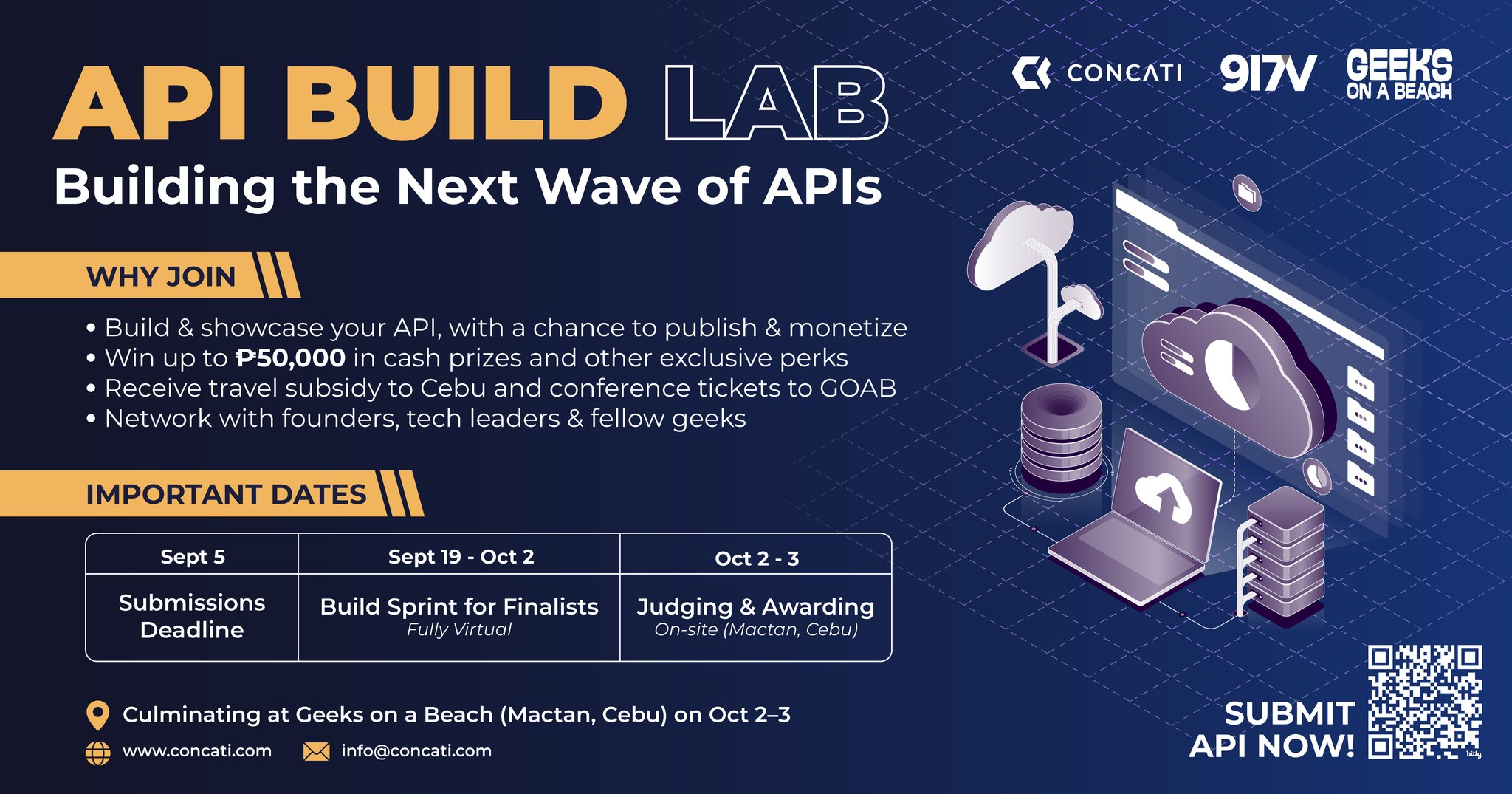
    Promotional graphic for the API Build Lab at Geeks on a Beach 2025, highlighting details about participation, prizes, and important dates.

    Cebu’s shores are set to buzz with innovation as Geeks on a Beach (GOAB) 2025 returns on October 1–3 at JPark Island Resort.

    This year, the iconic beachside tech conference will host the API Build Lab Finale, spotlighting Southeast Asia’s most promising API-driven solutions.

    Organized with 917Ventures’ Concati, the competition brings developers through a two-week sprint before pitching live in Cebu.

    Winners can bag up to ₱50,000 and get global exposure through Concati’s marketplace.

    Since 2013, GOAB has bridged startups, investors, and innovators, cementing its place as a launchpad for the region’s digital future.

  • Geeks on a Beach 2025 to Spotlight Tech Innovation with API Build Lab Finale

    Geeks on a Beach 2025 to Spotlight Tech Innovation with API Build Lab Finale

    Promotional graphic for the API Build Lab at Geeks on a Beach, featuring event details such as dates, cash prizes, and submission information.

    Geeks on a Beach (GOAB), the premier international tech conference in the Philippines, will return on October 1–3, 2025, in Cebu. Staying true to its legacy of conversations by the surf leading to global collaborations, this year’s GOAB will feature the API Build Lab Finale. The event is a unique competition showcasing the most promising API-driven solutions from Southeast Asia.

    An API (Application Programming Interface) functions like a digital server. It enables different software applications to communicate with one another, allowing businesses to use existing tools and services, such as maps or payment systems, without needing to create them from scratch. APIs not only save time and money but also result in improved and more integrated services for users.

    The API Build Lab, organized in partnership with 917Ventures through its API venture Concati, invites developers and startups from the region to submit new or existing API concepts that demonstrate strong commercialization potential. Finalists will participate in a two-week virtual Build Sprint from September 19 to October 2, where they will receive hands-on coaching and mentoring. They will then have the opportunity to pitch their solutions live at the GOAB event.

    Since its inaugural edition in 2013, GOAB has served as a launchpad for startups, investors, and innovators throughout Asia to connect, collaborate, and create. By hosting the API Build Lab finale, the conference upholds its tradition of highlighting the future of technology in the Philippines and Southeast Asia, this time focusing on developers and the API economy.

    “Geeks on a Beach has always focused on fostering collaboration and innovation,” said Tina Amper, the organizer and advisor for GOAB. “Hosting the API Build Lab finale at this year’s conference is a natural extension of our mission to provide builders, founders, and communities a platform to shine, while highlighting the Philippines as an emerging hub for tech-driven solutions,” said Amper.

    The top finalists of the 5 API Build Lab will be flown to Cebu, receiving travel allowances, AWS credits, and complimentary GOAB passes. They will pitch live on stage, and winners will be crowned.

    • ₱50,000 – Grand Winner
    • ₱30,000 – 2nd Place
    • ₱20,000 – 3rd Place

    Winning APIs can also be published and monetized on Concati’s open-exchange marketplace, providing developers with a way to scale their solutions globally.

    “With API Build Lab, we aim to foster innovation by empowering developers to turn their ideas into real-world solutions,” said Vince Yamat, Managing Director of 917Ventures. “Our partnership with GOAB enables us to showcase this talent on the largest platform for startups and technology in the Philippines,” said Yamat. 

    GOAB began as an ambitious idea to bring technology leaders together by the beach and has now evolved into a significant gathering that advances Southeast Asia’s innovation ecosystem. This year, with the introduction of the API Build Lab, GOAB reaffirms its role not just as a platform for discussions, but also as a launchpad for the next wave of solutions in fintech, e-commerce, logistics, and more.

    Developers and startups can submit their API ideas at bit.ly/apibuildlab

    Key Dates

    • Submission Deadline: September 5, 2025
    • Virtual Build Sprint: September 19 – October 2, 2025
    • Final Pitch and Awarding: October 2–3, 2025 at GOAB Cebu

    About 917Ventures

    917Ventures is one of the largest venture builders in Southeast Asia and the tech innovation arm of the Globe Group. We are home to some of the most successful digital pioneers in the country like GCash, KonsultaMD, AdSpark, m360, and Rush Technologies. We build businesses that uplift the lives of Filipinos through digital inclusion and enablement. To know more about 917Ventures, you may visit: https://917ventures.com.  

    About Geeks on a Beach

    Geeks on a Beach is the Philippines’ pioneering beachside international tech and startup conference, launched in 2013. Known for its unique blend of serious conversations in a fun, laid-back environment, GOAB has connected thousands of entrepreneurs, investors, developers, creatives, and policymakers. Over the years, GOAB has helped catalyze deals, investments, and partnerships that continue to shape the Philippine and Southeast Asian startup landscape.

    This year’s GOAB will be held on 1-3 October 2025 at JPark Island Resort Hotel in Mactan, Cebu. It is organized by the non-profit group geeksPH with the support of its foundational government partner, the Department of Information and Communication Technology (DICT). To join Geeks On A Beach, purchase tickets at https://geeksonabeach.com or email hello@geeksonabeach.com. Discounted tickets are available for a limited period. 

  • Murder at Burning Man: Tech Elite’s Desert Oasis Turns Deadly

    Murder at Burning Man: Tech Elite’s Desert Oasis Turns Deadly

    Burning Man’s final weekend spiraled into chaos after a man was discovered dead “lying in a pool of blood” during Saturday night’s iconic effigy burn, sparking a homicide investigation in the Nevada desert.

    Authorities said the victim’s identity remains unknown, but deputies and forensic teams swiftly secured the site.

    The death casts a grim shadow over a festival long tied to Silicon Valley’s most powerful figures, from Elon Musk and Jeff Bezos to Google’s founders.

    With the temporary city set to vanish by week’s end, investigators face a race against time to solve Burning Man’s most chilling mystery yet.

  • 8 Dark Truths About the Murder That Shattered Burning Man’s Final Night

    8 Dark Truths About the Murder That Shattered Burning Man’s Final Night

    Burning Man has always been a mix of art, freedom, and eccentricity. But this year, the festival known as Silicon Valley’s desert playground was jolted by a shocking homicide.

    What should have been a night of fire and spectacle ended with flashing sirens and police tape.

    Here are the most striking details surrounding the case that turned celebration into crime scene.

    1. A Murder Amid the Flames
      Just as the iconic wooden “Man” effigy was set ablaze Saturday night, a participant found a man “lying in a pool of blood” and rushed to flag down authorities.
    2. Victim Remains a Mystery
      The deceased has only been identified as a white adult male. His name, background, and ties to the event are still unknown.
    3. The Desert Became a Police Zone
      Within minutes, deputies and rangers swarmed the site, sealing off the area. Forensic experts from Washoe County gathered evidence while festivalgoers watched a surreal mix of fire and flashing lights.
    4. A Magnet for Tech Royalty
      Once a counterculture gathering, Burning Man became a networking hub for Silicon Valley giants. Elon Musk, Mark Zuckerberg, and Jeff Bezos have all made appearances in past years.
    5. Google’s Founders Cemented the Legacy
      Larry Page and Sergey Brin are long-time “Burners.” Their devotion runs so deep that the very first Google Doodle in 1998 was designed to signal their absence while attending the festival.
    6. Past Deaths Haunt the Playa
      This isn’t the first tragedy in Black Rock City. From a man running into the fire in 2017 to fatal crashes over the decades, the festival has a history of dark chapters.
    7. Life Begins, Too
      In a bizarre twist of fate, a baby named Aurora was born at this year’s event. The parents reportedly had no idea they were expecting, adding to Burning Man’s reputation for the unexpected.
    8. A City That Disappears in Days
      Sheriff Jerry Allen admitted the case is unusually complicated because Burning Man is temporary. By midweek, the desert city will vanish, along with potential witnesses.

    The murder has cast a shadow over Burning Man’s 38-year history. As the community of 70,000 dismantles its utopian city and heads home, one question lingers in the desert air: who turned this celebration of radical expression into a scene of bloodshed?

  • Lucy Guo Built a $1.3B Fortune After Dropping Out of College — Here’s How

    Lucy Guo Built a $1.3B Fortune After Dropping Out of College — Here’s How

    A side-by-side image featuring a woman with long hair in a relaxed pose against a gradient background, alongside another woman looking up while standing outdoors with a green traffic light in the background. The logo of 'Scale' is positioned prominently in the center.

    Lucy Guo, the 30-year-old founder of creator platform Passes, has been named Forbes’ youngest self-made billionaire with a net worth of $1.3 billion.

    The serial entrepreneur first co-founded Scale AI, later acquired by Meta in a $25 billion deal, before launching her latest ventures, including Backend Ventures and Passes.

    Guo’s money-making drive began in childhood, trading Pokémon cards and selling Neopets items online.

    Raised by frugal Chinese immigrant parents in Fremont, California, she was pushed toward academics but ultimately dropped out of Carnegie Mellon to join the Thiel Fellowship.

    Today, Guo’s ventures face both success and scrutiny. Passes, her creator monetization startup launched in 2022, is currently facing a lawsuit alleging distribution of illicit content — claims the company strongly denies.

    Despite challenges, Guo remains one of the most closely watched young billionaires in the tech world, embodying both the promise and pitfalls of modern entrepreneurship.

  • Data Center Servers Explained: Bare Metal, Virtualization, and Storage 

    Data Center Servers Explained: Bare Metal, Virtualization, and Storage 

    Not all servers in a data center are created equal. Some are built for raw power, others for flexibility, and others for storing the mountains of data that businesses generate every second.

    Whether you’re running an online store, a banking application, or a global video platform, the type of server your workloads run on will shape performance, reliability, and cost.

    For data center customers, it pays to know the difference between bare metal servers, virtualized environments, and storage systems.

    Each has unique strengths, limitations, and ideal use cases. Knowing when to choose one over the other can mean the difference between overpaying for unused capacity and optimizing every dollar you spend.

    Bare Metal Servers: Raw Power, No Sharing

    Bare metal servers are physical machines dedicated to a single tenant. Unlike virtual machines, you’re not sharing CPU, memory, or storage with anyone else. This means predictable performance, which is crucial for applications that demand high compute power.

    Example use cases:

    High-frequency trading platforms that can’t risk microsecond delays. Large gaming servers needing consistent performance. Healthcare systems processing sensitive medical data where compliance forbids resource sharing.

    Troubleshooting tip: If you experience lag on bare metal, it’s usually due to hardware issues (e.g., failing disk, overheating) rather than shared resources. Always confirm your provider has proactive monitoring in place.

    Virtualization: Flexibility and Efficiency

    Virtualization allows a single physical server to run multiple virtual machines (VMs). This maximizes resource usage and offers scalability: you can spin up new VMs in minutes rather than waiting for hardware.

    Example use cases:

    SaaS providers running multiple customer instances on one host. Startups that need to scale fast without investing in physical servers. Development teams that need separate testing environments without extra hardware.

    Troubleshooting tip: Performance dips may be due to “noisy neighbors” — other VMs consuming excessive resources. Ask your provider about VM isolation, resource caps, or moving critical workloads to dedicated nodes.

    Storage Systems: The Data Backbone

    Data doesn’t just live on compute servers — it needs specialized storage systems that balance speed, durability, and capacity. Storage in data centers generally falls into three categories:

    Block Storage: High-performance, low-latency. Best for databases and transaction-heavy applications. File Storage: Shared file systems that multiple servers can access. Ideal for collaboration platforms or content repositories. Object Storage: Scalable and cost-efficient, used for unstructured data like media files, backups, or big data analytics.

    Example use cases:

    Banks use block storage for transaction records. Enterprises use file storage for shared workspaces. Streaming services use object storage to house video libraries.

    Troubleshooting tip: Slow queries may indicate misaligned storage type. For instance, running a database on object storage will cause performance headaches. Match workloads with the right storage medium.

    Putting It All Together

    In practice, most businesses use a mix of all three. A modern e-commerce company, for example, might use bare metal servers for its payment gateway (ensuring no downtime), virtualization for its marketing and analytics environments (to scale up easily), and object storage for its product images and videos.

    Quick Customer Reference

    Bare Metal = Best for maximum performance and compliance-heavy workloads.

    Virtualization = Best for agility, cost efficiency, and fast scaling.

    Storage Systems = The foundation; choose block for speed, file for collaboration, object for scalability.

    Choosing the right server type in a data center isn’t just a technical decision — it’s a business one. Bare metal delivers raw power, virtualization offers unmatched flexibility, and storage systems form the backbone of every digital service.

    By understanding how each works and when to use them, customers can make smarter choices, reduce costs, and ensure their services run without interruption.

  • Explainer: What Fusion CX’s Expansion Means for the Philippines’ CX Landscape

    Explainer: What Fusion CX’s Expansion Means for the Philippines’ CX Landscape

    What did Fusion CX just announce?
    Fusion CX has launched two new facilities in the Philippines—an 836-seat center in Manila and a 275-seat site in Legazpi City—marking its 15th year in the country and signaling deeper long-term investment.

    Why expand in these locations now?
    The company is aiming to decentralize talent development and promote inclusive growth. By expanding in both an urban hub like Metro Manila and a regional city like Legazpi, Fusion CX is betting on both scale and resilience.

    What’s special about the Manila center?
    Located at 500 Shaw Boulevard, the tech-enabled facility features an AI Solutions Command Hub powered by Fusion’s subsidiary, Omind. The center also includes multichannel delivery zones, collaborative workspaces, and scalable infrastructure designed to grow with client demand.

    What does this mean for Filipino talent?
    The expansion reinforces Fusion CX’s trust in Filipino professionals. The company already employs over 500 people at the new Manila site and is actively developing talent in Legazpi. It’s a strong signal that CX jobs will continue to shift toward regional inclusion.

    How is technology shaping Fusion CX’s operations?
    The company is integrating real-time agent assistance, conversational AI, sentiment analysis, and accent harmonization into its workflows. These tools are part of a broader strategy to elevate customer experience through automation and AI-powered insights.

    What did company leaders say?
    Co-founder and CEO Pankaj Dhanuka emphasized that the Philippines is not just a delivery hub but a strategic growth engine. COO Kishore Saraogi added that the Manila center sets a new benchmark for AI-powered, people-first customer service delivery.

    What happened during the launch?
    The July 28 inauguration of the Manila site gathered government officials, global clients, and community stakeholders, reinforcing the company’s commitment to innovation and regional development.

    How does this reflect broader CX trends?
    Fusion CX’s expansion mirrors the growing demand for digital-first, multilingual, and decentralized CX services. It also reinforces the Philippines’ role as a global leader in customer experience outsourcing.

  • Top 3 Tech Startups to Watch from Shell LiveWire 2025

    Top 3 Tech Startups to Watch from Shell LiveWire 2025

    Shell Pilipinas has named its three most promising tech startups under its 2025 Shell LiveWire program.

    The annual initiative is Shell’s flagship enterprise development program designed to accelerate Filipino-led startups tackling sustainability, agriculture, and clean energy challenges.

    After a competitive pitch event in June, three standout ventures were selected for their groundbreaking solutions.

    1. Agridom: Precision Farming with Drones
    Agridom, developed by SF Group of Companies Inc., is revolutionizing agriculture for smallholder farmers by using drone-powered tools that boost farming efficiency and sustainability.

    The technology aims to modernize local farms through smart data, reduced input waste, and improved yields.

    2. Greentech Ecobooster: Cutting Emissions, Boosting Engines
    Greentech Ecobooster introduces a fuel optimization device that enhances engine combustion while cutting fuel use and emissions.

    The innovation supports cost efficiency and climate goals by reducing greenhouse gases in transportation and industrial operations.

    3. Pili AdheSeal: Turning Waste into Green Adhesives
    Pili AdheSeal Inc. transforms Pili tree waste into eco-friendly adhesives and sealants, promoting circular economy practices and providing new income streams for farmers.

    The startup supports sustainable manufacturing while reducing reliance on synthetic chemical-based products.

    These three startups have entered Shell LiveWire’s acceleration phase, where they will receive expert mentorship, team and product development funding, and pitch training.

    Winners will be announced in September at the Shell LiveWire 2025 finale during the Echelon Event, with the top startup receiving PHP 1 million in equity-free cash, and the two runners-up earning PHP 500,000 each.

    Shell is also supporting 51 community enterprises from across the country with in-kind grants, helping regional businesses build stronger local impact.

    Nascent Technologies Corp. was given the “A-Lister” award, a special recognition for early-stage startups with strong potential.

    Shell appointed PwC as its official auditor for the program to ensure transparency and integrity in the selection process.

    According to reports, the Philippines’ startup ecosystem grew from US$3.5 billion in 2023 to US$6.4 billion in 2024, fueled by investments in cleantech, agritech, healthtech, and education tech.

    Shell LiveWire is positioning itself at the center of that growth by nurturing local innovations with long-term environmental and economic value.

  • Huawei Unveils Pura 80 Series with Game-Changing Dual Telephoto Camera, Set to Launch in PH

    Huawei Unveils Pura 80 Series with Game-Changing Dual Telephoto Camera, Set to Launch in PH

    Huawei is once again pushing the boundaries of mobile photography with the upcoming launch of the Pura 80 Series in the Philippines this August.

    Leading the charge is the HUAWEI Pura 80 Ultra, which debuts the world’s first Switchable Dual Telephoto Camera, a bold innovation aimed at redefining the mobile imaging experience.

    This feature merges two focal lengths — a 3.7x mid-telephoto lens and a 9.4x ultra-telephoto lens — within a single unit, supported by a large 1/1.28-inch sensor that maximizes light intake for richer, deeper shots.

    Huawei’s new shading mechanism, paired with micron-level motor control, allows the lens system to shift seamlessly between the two focal lengths, enabling striking zoom photography without compromising quality.

    With over 140 precision parts working in harmony, the mechanism provides a 129 percent increase in light path compared to traditional telephoto modules.

    The HUAWEI Pura 80 Pro also delivers impressive photography power, sporting an Ultra Lighting Macro Telephoto Camera that can focus as close as 5cm, opening up possibilities for highly detailed macro shots.

    A large F2.1 aperture enhances the sensor’s light sensitivity, capturing 40 percent more light to produce vivid images even in low-light scenarios.

    Both models are the latest iteration of the HUAWEI Pura Series, a rebranded continuation of the former P Series which has defined Huawei’s legacy in mobile photography innovation.

    Since the launch of the original P Series in 2012, Huawei has repeatedly raised the bar with features like the P9’s dual-lens camera, the P30’s periscope lens, and the P60’s ultra-lighting macro telephoto capabilities.

    In 2024, Huawei reintroduced the series under the “Pura” name, marking a new direction that blends cutting-edge imaging with refined, fashion-forward design.

    The Pura 80 Ultra is further enhanced with a 1-inch Ultra Lighting HDR Camera, capable of capturing up to seven times more photons than its predecessor due to a 400,000 e⁻ full-well electron capacity per pixel.

    Using real-time TCG-HDR processing, the camera processes multiple signals simultaneously to achieve a dynamic range of up to 16EV — fifteen times greater than before — making it a powerhouse for challenging lighting environments.

    With AI Cinematic Engine support, the phone is also capable of video capture that mirrors the human eye’s perception, with natural contrast and accurate colors even in scenes with high light disparity.

    Meanwhile, the Pura 80 Pro isn’t far behind, featuring its own 1-inch Ultra Lighting Camera that delivers stunning night photography when paired with an Ultra Chroma Camera.

    Design remains a signature focus for Huawei, with both devices sporting the brand’s elegant Forward Symbol aesthetic inspired by sunray patterns from luxury watches and jewelry.

    The Pura 80 Ultra is available in Prestige Gold and Golden Black, while the Pura 80 Pro comes in Glazed Red, Glazed White, and Glazed Black, featuring a monochrome glaze texture finish that underscores Huawei’s pursuit of craftsmanship.

    Durability is not an afterthought either.

    The Pura 80 Ultra uses 2nd Gen Crystal Armor Kunlun Glass for enhanced scratch and drop resistance, while the Pura 80 Pro is fitted with next-gen KUNLUN Glass and offers similar rugged protection.

    Both devices boast top-tier IP ratings, with the Ultra rated IP69 and the Pro at IP68 for water and dust resistance.

    Filipino consumers can preview the Pura 80 Series at select Huawei Experience Stores from July 26 to August 10, with special events scheduled every weekend at 3:00 PM.

    Those who pre-order between July 10 and August 6 with a PHP 500 deposit will receive PHP 3,000 off the total price, with redemption from August 7 to 28.

    Early bird vouchers worth PHP 2,000 will also be available on e-commerce platforms such as Shopee, Lazada, and TikTok Shop starting July 31 for both models.

    As Huawei continues its relentless pursuit of imaging excellence, the Pura 80 Series cements the brand’s leadership in mobile photography with powerful hardware, intelligent imaging, and a style-forward design philosophy that refuses to compromise.