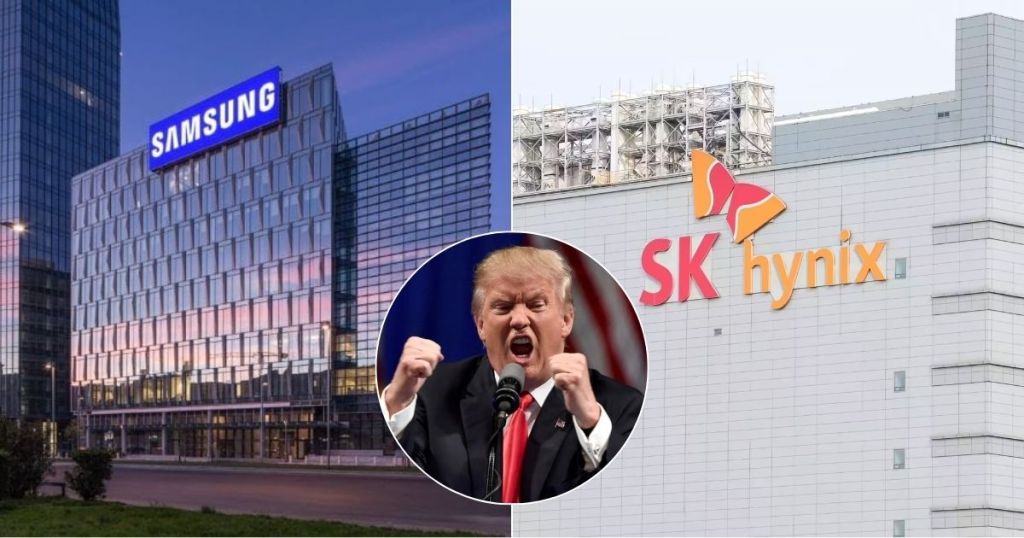
The U.S. has turned up the pressure on South Korea’s top chipmakers, revoking special permissions that once allowed Samsung and SK Hynix to freely use American equipment in their Chinese plants. The decision comes as Washington doubles down on restricting Beijing’s access to advanced semiconductor technology.
With a 120-day countdown before the new rules bite, the fallout could reshape everything from global memory chip supplies to U.S.-China trade dynamics. Here are the eight biggest takeaways from the crackdown.
1. Exemptions Revoked
For nearly three years, Samsung and SK Hynix operated their semiconductor plants in China with special exemptions that allowed them to use American chipmaking equipment without going through the standard export license process. This arrangement was crucial because U.S. firms dominate the high-end semiconductor equipment market.
With the exemptions now revoked, these companies lose a major operational advantage. It means every piece of advanced U.S. gear—from etching machines to lithography tools—will require paperwork, waiting periods, and U.S. government approval, dramatically slowing production cycles and raising the risk of delays in chip deliveries.
2. Licenses Now Mandatory
Moving forward, South Korean chipmakers must request licenses for every purchase of U.S. semiconductor equipment for use in China. These licenses are not automatically granted and can be denied if Washington believes the technology could indirectly benefit China’s domestic chip development.
The process introduces an extra layer of bureaucracy and uncertainty that can last months, sometimes years.
For companies like Samsung and SK Hynix, which rely on fast equipment upgrades to stay competitive in memory chips, this change adds serious operational risk. It transforms day-to-day business decisions into geopolitical chess moves.
3. Intel Also Dragged In
Intel, although it sold its Dalian memory facility earlier this year, was also stripped of its authorization. While Intel no longer has a direct Chinese production base, the inclusion underscores the U.S. government’s determination to create a blanket approach.
It sends a message to all foreign and American chipmakers that no exceptions will be tolerated, regardless of past investments or withdrawals.
The decision also complicates Intel’s broader Asia strategy. Even without a Chinese factory, Intel still sources materials, collaborates with Asian foundries, and depends on regional supply chains that now face heightened scrutiny and barriers.
4. 120 Days Until Enforcement
The new rules will not be enforced immediately. Instead, companies have 120 days to prepare for the transition. On paper, this window offers time to adjust procurement plans, secure pending shipments, and consult with both Washington and Seoul. In reality, it is a frantic countdown.
Four months is a very narrow period in semiconductor manufacturing, where procurement, testing, and installation of new machines can stretch over half a year. The grace period is less of a cushion and more of a pressure cooker, pushing firms to make quick, high-stakes decisions under diplomatic and financial stress.
5. No Expansion or Upgrades Allowed
Even if Samsung and SK Hynix manage to obtain licenses, the U.S. Commerce Department has made clear these will only cover basic operations of existing facilities.
No licenses will be issued to expand manufacturing capacity or to install the next generation of tools required for cutting-edge chips. That effectively freezes the technological level of their Chinese fabs, preventing them from moving beyond current production nodes.
In a business where advancement is measured in nanometers, being barred from upgrades means falling behind global rivals. It’s a strategic ceiling placed on foreign firms in China, one difficult to break.
6. South Korea Pushes Back
The South Korean government has already emphasized the crucial role its companies play in the global chip supply chain. Samsung and SK Hynix together control more than half of the world’s memory chip market, with Chinese factories contributing significantly to that output.
Seoul has warned that destabilizing these operations risks undermining global electronics production, from smartphones to servers. Officials are now engaged in intense talks with Washington, seeking carve-outs or flexibility.
Their argument rests on the idea that punishing Korean firms ultimately hurts American allies and consumers, while providing little long-term gain against China’s ambitions.
7. China and Competitors May Gain
China’s Ministry of Commerce condemned the decision and vowed retaliation, signaling it will defend the interests of Chinese enterprises. The restrictions could ironically accelerate Beijing’s own efforts to develop domestic equipment alternatives, giving firms like SMEE and Naura new opportunities.
At the same time, U.S. chipmaker Micron stands to benefit, since it competes directly with Samsung and SK Hynix in the memory market.
By limiting Korean production capacity in China, the U.S. indirectly helps one of its own champions. The policy thus redistributes competitive advantage, reshaping not only political alliances but also the balance of corporate power.
8. Market Shock and Tech War Escalation
The market has already reacted. Shares of Lam Research, Applied Materials, and KLA—all leading U.S. equipment makers—fell sharply as investors digested the prospect of reduced sales to China.
Billions of dollars in export licenses are now backlogged, leaving shipments in limbo. More broadly, this move intensifies the technology conflict between the U.S. and China.
It shows Washington is willing to tighten the screws on allies as well as rivals, raising questions about how long other nations will tolerate collateral damage. For Samsung and SK Hynix, the message is clear: their China gamble just got far riskier.
The Bigger Picture
This policy shift is more than a trade rule—it is a signal that the U.S.-China tech rivalry is entering a sharper, more aggressive phase.
South Korean giants now face difficult choices about whether to double down in China, diversify to other regions, or absorb losses to protect market share.
For China, the decision is a wake-up call to accelerate self-reliance. And for Washington, it is a gamble that cutting off allies’ access in China will be worth the risk of rattling the global supply chain.
The semiconductor battlefield just got more unpredictable.






Leave a Reply