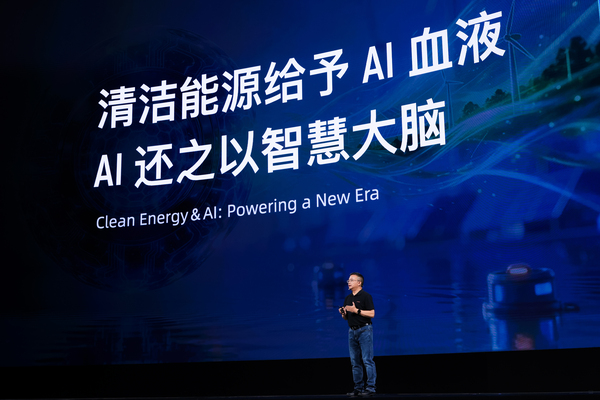
Clean energy and artificial intelligence are forming a symbiotic relationship where renewable power sustains computing demands and AI provides intelligent system control, according to Sungrow Senior Vice President and Chief Scientist David Zhao.
Speaking at the 2026 APSARA Conference in Hangzhou on Sept. 23, Zhao delivered a keynote titled “Clean Energy & AI: Powering A New Era,” detailing 10 technology trends transforming the convergence of power electronics and digital infrastructure.
Massive Growth Ahead for Renewable Capacity and Storage
The scale of the energy transition is accelerating rapidly. By mid-year, China’s installed solar PV capacity reached 1,286 GW, overtaking coal-fired power for the first time as the country’s largest installed generation source.
However, energy storage capacity lags significantly behind future requirements:
- Current global electrochemical energy storage stands at 700 GWh.
- Projected demand is estimated to reach 15 TWh by 2050.
- Current capacity fulfills only 5% of future demand, requiring a nineteenfold increase.
Zhao projects rapid expansion over the next five years across solar, wind, energy storage, electric vehicles, and hydrogen, alongside dedicated power supplies for AI facilities. Clean energy technologies are set to account for more than 60% of future emissions reductions, with clean power demand expected to reach three to four times current installed capacity.
Engineering and Operational Barriers for AI Data Centers
Integrating clean energy into AI computing infrastructure presents three primary challenges:
- Power Demand and Carbon Limits: China’s data center electricity consumption is projected to reach 800 billion kWh by 2030, with individual computing parks requiring gigawatt-scale power. National mandates require new data centers at designated hubs to source over 80% of their electricity from renewables.
- Technology Transition: Solid-state transformers (SSTs), which directly convert 10 kV or 35 kV AC to 800V DC to cut weight and footprint, remain in transition from demonstration phases to large-scale deployment.
- Power Electronics Barriers: Applying AI to power systems faces four engineering hurdles: a scarcity of real-world fault data, the impossibility of relying solely on AI for microsecond-level control, risks from model extrapolation requiring physical constraints, and a lack of industry standards for black-box failure accountability.
Ten Technological Trends Shaping the Future
Zhao outlined 10 core trends spanning power architecture, topology control, operating life, and system coordination:
- Trend 1 — Computing Shifts Toward Renewable Power: Direct renewable power supply can secure electricity prices of RMB 0.2–0.3 per kWh, lowering total ownership costs.
- Trend 2 — DC Architecture for AI Computing Centers: 800V DC is emerging as a new standard targeting end-to-end system efficiency above 94%.
- Trend 3 — Commercial SST Deployment: Data centers will catalyze commercial adoption by 2027, leveraging SSTs to reduce footprint by 30% and weight by 50%.
- Trend 5 — Edge AI Grid-Forming Control: Grid-forming converters are forecast to surpass a 40% penetration rate by 2028.
- Trend 9 — Long-Duration and Multi-Energy Storage: Iron-air and iron-flow batteries will support hundred-hour storage, green hydrogen will provide seasonal storage, and natural gas paired with solid oxide fuel cells (SOFCs) will handle peak backup.
- Trend 10 — Coordinated Computing and Power Dispatch: Energy management systems will coordinate across millisecond-to-seasonal timescales, allowing gigawatt-scale AI centers to act as flexible, dispatchable grid assets.
Commercializing SST Power Solutions
To address these hardware demands, Sungrow launched EnerNeo on July 9—its first proprietary solid-state transformer built on an 800V DC architecture with Silicon Carbide (SiC) devices. The unit offers 99.999% availability, 98.5% system efficiency, and a power density of 312 kW/m².
The company signed strategic cooperation agreements with HEC Group and ZDATA, delivering SST products to customers for commissioning in the fourth quarter. The deployment is expected to be among the first to operate an 800V DC SST power supply under real-world AI computing loads.
In addition, Sungrow established the Green Token Joint Innovation Center with Alibaba Cloud in July to advance low-carbon computing infrastructure. Sungrow’s broader “AI for ALL” architecture emphasizes source-load coordination, direct renewable supply, and virtual power plant integration.
“Clean energy gives AI the power it needs to thrive, while AI gives clean energy an intelligent brain. The two empower and complement each other,” Zhao said during his address, emphasizing that power electronics act as the fundamental bridge between the two sectors.

Leave a Reply