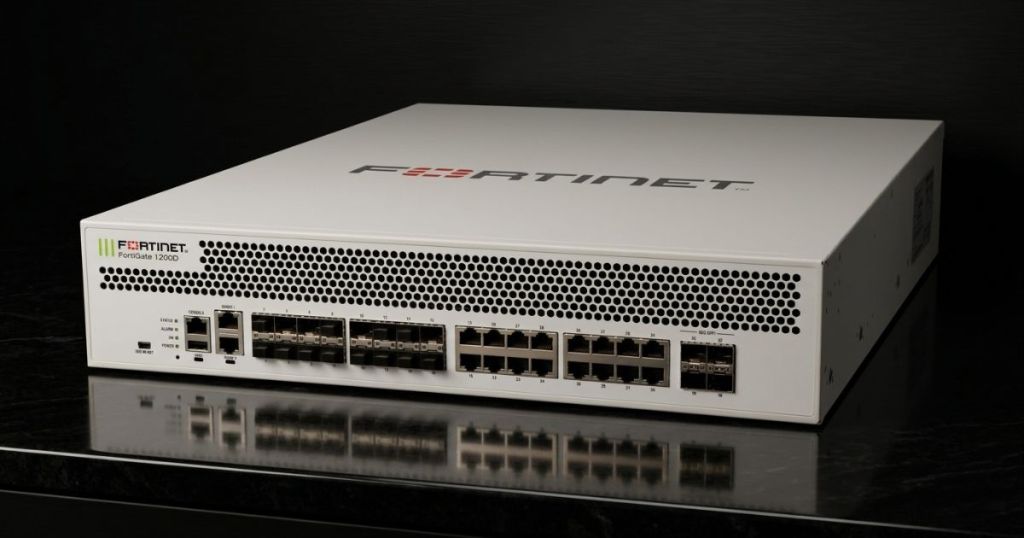
Cybersecurity leader Fortinet has announced the FortiGate 1200G series, introducing a hardware line designed to handle heavy AI infrastructure demands alongside FortiSASE Outpost capability.
The new release allows enterprise security teams to run cloud-delivered security services directly inside their own physical environments.
By unifying local firewall enforcement with cloud security mechanisms under a single operating system (FortiOS), the platform addresses growing corporate needs around latency, high-bandwidth data processing, and strict regulatory compliance.
Bridging local control and cloud security
As artificial intelligence adoption, heavy data traffic, and encrypted connections scale up across data centers, traditional security architectures face processing bottlenecks. The FortiGate 1200G series solves this by functioning both as a standalone high-performance firewall and as a localized FortiSASE Outpost—essentially creating an on-site SASE point-of-presence (POP).
This hybrid approach allows organizations to decide where traffic inspection happens. Latency-critical or privacy-sensitive data can be processed on-premises, while general traffic routes through cloud-based SASE POPs.
“The convergence of firewall and SASE technologies is creating a new SASE firewall market built for the realities of today’s hybrid world,” said Ken Xie, Founder, Chairman of the Board, and CEO of Fortinet. “Fortinet anticipated this shift by building FortiGate and FortiSASE on FortiOS and investing in proprietary ASIC technology that delivers security and performance at scale from day one. The FortiGate 1200G with FortiSASE Outpost capability advances this vision by combining local enforcement and cloud-delivered security to address customers’ evolving sovereignty, performance, and AI infrastructure requirements.”
Hardware performance and technical specifications
The FortiGate 1200G series leverages custom FortiASIC architecture to maintain high throughput without degrading application speed. The hardware features flexible 10G, 25G, and 100G port configurations, hardware-rooted platform integrity, secure credential storage, and built-in redundancy to maximize business continuity.
According to Fortinet, performance benchmarks against key industry competitors show significant metric advantages across major security metrics:
- Firewall Throughput: 397.0 Gbps (compared to a competitor average of 84.9 Gbps)
- IPSec VPN Throughput: 102.0 Gbps (compared to a competitor average of 28.8 Gbps)
- Threat Protection: 40.0 Gbps (compared to a competitor average of 20.9 Gbps)
- IPS Throughput: 54.0 Gbps (compared to a competitor average of 23.5 Gbps)
- Concurrent Sessions: 40 million (compared to a competitor average of 14.8 million)
The hardware also aims for higher energy efficiency, consuming 1.9 Watts per Gbps of firewall throughput compared to the competitive market average of 10.2 Watts per Gbps.
Industry analysts highlight that flexible enforcement architectures prevent long-term technical debt as corporate AI strategies expand.
“Converged SASE and firewall platforms provide the flexibility to meet dynamic, AI-accelerated network architectures where they are, rather than becoming part of next year’s technical debt,” said Pete Finalle, Research Manager at IDC. “Buyers that judge platforms only by how well they fit today’s environment, rather than how effectively they can adapt to tomorrow’s, are already behind.”
Supporting AI workflows and geographic compliance
With AI applications and autonomous agents generating vast amounts of local (“east-west”) network traffic, forcing all data through distant cloud data centers introduces unnecessary latency and increases bandwidth expenses.
By placing a FortiSASE Outpost on-site near large clusters of users or local data repositories, organizations shorten network paths while preserving uniform access controls. Centralized policy management through the FortiSASE dashboard ensures that security rules, threat intelligence from FortiGuard AI-Powered Security Services, and automated responses via FortiAI remain identical across both local hardware and cloud nodes.
This model also keeps sensitive activity logs, customer records, and processing actions strictly within targeted regional or jurisdictional boundaries to meet strict data sovereignty regulations.
“Organizations should not have to choose between the scalability of cloud-delivered security and the performance, control, or sovereignty of on-premises enforcement,” said Will Townsend, Chief Analyst, LoneStar Advisory and Research. “The convergence of these models is creating a meaningful new SASE firewall market. Fortinet is well positioned for this shift, enabling customers to apply security through cloud-delivered FortiSASE or locally with the FortiGate 1200G and with FortiSASE Outpost, based on what their business requires, while maintaining consistent policy, visibility, and user experience.”
Availability
The FortiGate 1200G series is expected to become commercially available in Q3 2026.





Leave a Reply