
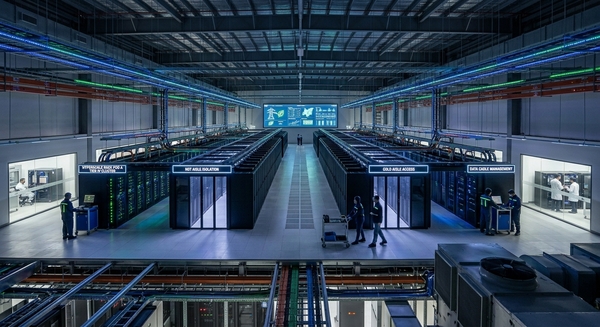
Ethereum co-founder Vitalik Buterin has sided with the movements opposing new AI data center construction, arguing that slowing the buildout would give society more time to prepare for cyber and biological risks.
In a post on X on November 8, 2026, Buterin defended the campaigns against new facilities. His focus was hyperscale AI compute: the warehouse-sized data centers that train and run the largest models.
Efficiency gains at the center of the argument
Buterin’s core claim concerns algorithmic efficiency. He suggested that work requiring more data centers two years from now could potentially be handled by existing infrastructure within four years, and likely sooner.
He also addressed what a slowdown would cost. Buterin indicated that an expected one-year slowdown in AI scaling would cause only minimal delays to scientific progress.
His reasoning is that many of the things holding science back are not compute problems. Running experiments, gathering data and testing results take time no matter how many GPUs are running in the background.
By his framing, the trade is lopsided. Society gives up a small amount of speed and gains a meaningful window to strengthen cybersecurity and reduce biological risks.
A practical pitch, not a doomsday one
Buterin’s remarks responded to an emotional backlash against the anti-data-center movements. He chose not to lean on the more controversial arguments about artificial general intelligence, or AGI, posing existential risk.
His pitch was narrower. You do not need to believe a superintelligence is coming for humanity to think defenses should be ready before the technology outpaces them.
The commentary drew most of its attention from crypto-focused outlets. The underlying debate, however, concerns AI infrastructure policy and how fast the industry should build, which extends well beyond blockchain circles.
Part of a pattern of recent warnings
The post follows two earlier statements from Buterin.
- October 2026: He warned that advances in AI could significantly weaken lattice-based cryptography within two years, and recommended adopting larger parameters in cryptographic practice.
- September 2026: He pointed to AI’s potential to strengthen cybersecurity by enabling formal verification of entire programs, rather than simply hunting for individual bugs.
Lattice-based schemes are a family of math puzzles used to protect data, and they are widely discussed as candidates for security that holds up against future computing threats. Larger parameters make those puzzles bigger and harder, trading some efficiency for a wider safety margin.
Formal verification is the difference between checking a bridge for visible cracks and mathematically proving it can bear a given load. Finding vulnerabilities one at a time is useful, but proving that whole programs behave as intended is a far stronger guarantee, and it has historically been expensive and slow.
Taken together, the three posts form a clear picture. AI may threaten cryptography soon, and it may also help build much stronger defenses. In Buterin’s view, a slower compute buildout gives the defensive side time to mature.
What it means for crypto
The most concrete takeaway for the industry sits in the October warning. If AI could weaken lattice-based cryptography within two years, protocol developers and wallet builders have a short runway to revisit their assumptions and parameter choices.
Buterin’s argument for slowing data center growth is, in part, an argument for giving those developers that runway. For anyone holding assets secured by cryptographic signatures, that makes it more than an abstract policy opinion.
His emphasis on formal verification is also worth watching. Smart contracts are programs that hold real money, and bugs in them have long been a source of losses across the sector. Tools that could prove whole contracts correct, rather than just patching discovered flaws, would address one of crypto’s most persistent weaknesses.
Buterin’s remarks show no evidence of an immediate market reaction, and he did not tie his comments to any specific project or token.
Policy implications and weak points
On the policy side, Buterin’s intervention adds a recognizable voice to the anti-data-center camp without the usual existential baggage. Critics of rapid AI buildout are often dismissed as alarmists, and a tech-native figure arguing that the cost of waiting is small and the benefit is real makes that harder.
The weak point in his case is the forecast itself. The claim that current infrastructure could handle future workloads within four years depends on algorithmic progress continuing at a healthy clip. If efficiency gains stall, a slowdown would cost more than he expects.
Likewise, the idea that a one-year delay would barely dent science rests on his read that non-compute bottlenecks dominate.
Still, the question Buterin is posing is not whether AI is good or bad. It is whether defenses are being built as fast as capabilities, and what a modest delay might be worth if they are not.



Leave a Reply